 |
CHAMÄLEON + ONJALA OBSERVATORY DeepSky | SITEMAP HOME CHAMÄLEON |
|
 |
|||
| « zurück zur Startseite
galaktische Nebel « back to home galactic nebula |
Großes Bild laden - load large image 1800 x 1400 Pixel Aufnahmedaten Image data |
 Objektbeschreibung Objektbeschreibung  Objekt
descripion Objekt
descripion |
Barnard 33, the Horsehead Nebula, IC 434, and NGC 2024
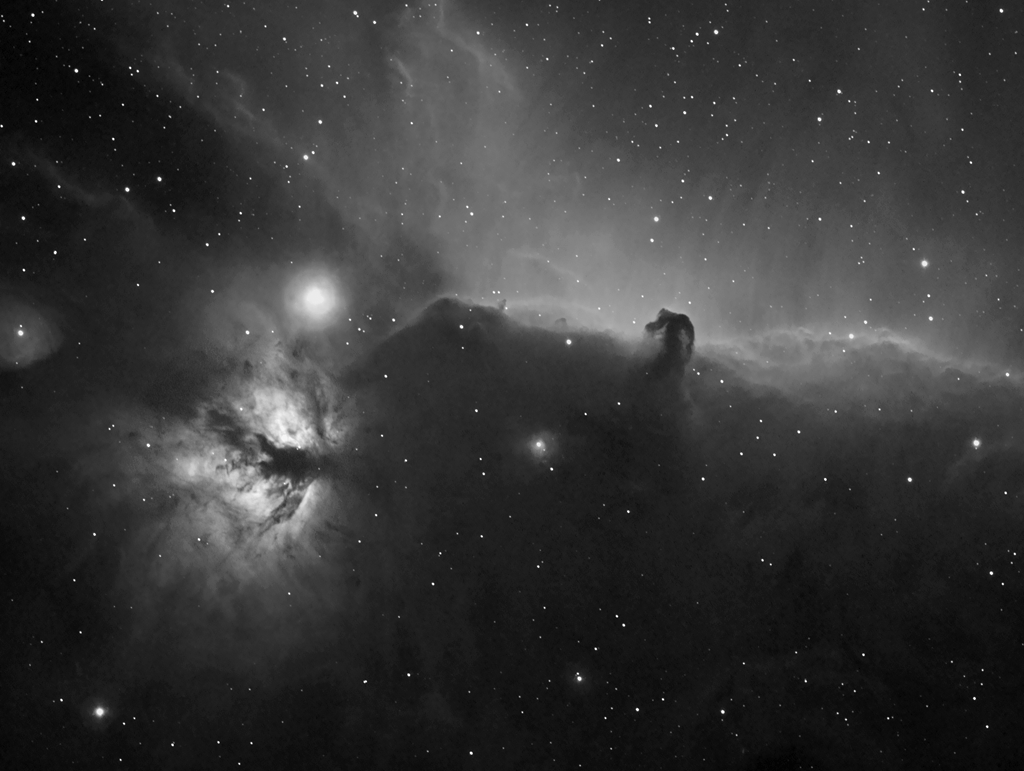
Barnard 33 - unser Bild zeigt den berühmten Pferdekopfnebel im Schmalband der H-alpha Linie. Links daneben NGC 2024, den Flammennebel. Barnard 33 ist eine dunkle Molekülwolke, die sich als markante Silhouette vor dem rot leuchtenden Wasserstoffgas von IC 434, LBN 950 und LBN 958 abhebt. Die Molekülwolke ist etwa 1.500 Lichtjahre vom Sonnensystem entfernt.
NGC 2024ist ein Emissionsnebel ebenfalls ewta 1.500 Lichtjahre entfernt. Er ist Teil des Orion-Komplexes, eines Sternentstehungsgebiets, zu dem unter anderem auch IC 434 mit dem Pferdekopfnebel und der Orion-Nebel gehören. Der Flammennebel wurde am 1. Januar 1786 von Friedrich Wilhelm Herschel entdeckt.
Object description
Barnard 33 - our image shows the famous Horsehead Nebula in the narrowband H-alpha line. To the left of it is NGC 2024, the Flame Nebula. Barnard 33 is a dark molecular cloud that stands out as a striking silhouette against the glowing red hydrogen gas of IC 434, LBN 950, and LBN 958. The molecular cloud is about 1,500 light-years away from the solar system.
NGC 2024 is an emission nebula, also located about 1,500 light-years away. It is part of the Orion Complex, a star-forming region that also includes IC 434 (the Horsehead Nebula) and the Orion Nebula, among others. The Flame Nebula was discovered on January 1, 1786, by Friedrich Wilhelm Herschel.
Image data
22.04.2026 - total 12 x 600 s, ASI 1600 Mono Pro + Baader H-alpha Filter, HWB = 7 nm
Telescope: Pentax SDP 105 at f = 670 mm
Location: Chamäleon Observatory, Onjala Lodge, Namibia
Image processing: DeepSkyStacker, PixInsight + Photoshop
 |
 |
 |
 |
 |
 |
 |
| Sonne | Mond | Sonnensystem | DeepSky | Weitwinkel | Verschiedenes | Spez. Projekte |