 |
CHAMÄLEON + ONJALA OBSERVATORY DeepSky | SITEMAP HOME CHAMÄLEON |
|
 |
|||
| « zurück zur Startseite
galaktische Nebel « back to home galactic nebula |
Großes Bild laden - load large image 2048 x 1400 Pixel Aufnahmedaten Image data |
 Objektbeschreibung Objektbeschreibung  Objekt
descripion Objekt
descripion |
NGC 5367 and CG 12 - a reflection nebula in the constellation Centaurus
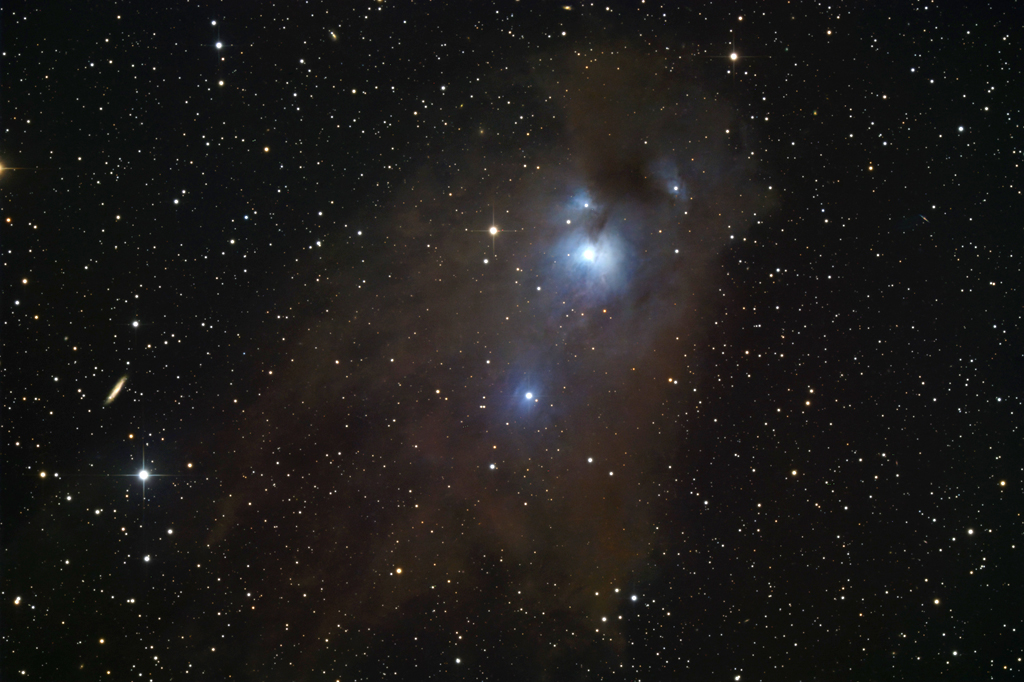
NGC 5367 - unser Bild zeigt den Reflektionsnebel NGC 5367, der eingebettet in die große Molekühlwolke CG 12 liegt. CG 12 wird als eine so genannte "kometare globule" klassifiziert. Eine Widefieldansicht der Region zeigen wir hier. Die blauen Sterne, die den Nebel beleuchten bilden das Doppelsternsystem h 4636, sie gehören den Spektraltyp B4 und B7 an. Der Abstand zwischen beiden Sternen beträgt ungefähr 2500 astronomische Einheiten. Ob die beiden Sterne ein physikalisches Sternsystem bilden ist unbekannt. Wenn ja, dann liegt die Umlaufperiode bei etwa 30.000 Jahren. NGC 5367 und CG 12 haben eine Entfernung von etwa 2000 Lichtjahre zum Sonnensystem.
Die Galaxie links der Bildmitte ist PGC 49 788. Sie ist eine nach Hubble klassifizierte SB Galaxie mit einer scheinbaren Größe von 1,5 x 0,4 Bogenminuten. Ihre visuelle Helligkeit ist ca. 14,5 Größenklasse, sie hat eine Entfernung von ungefähr 160 Millionen Lichtjahre zur Erde. NGC 5367 wurde am 26. Juni 1834 von John Herschel entdeckt. Auch beobachtet am 30. Dezember 1897 vom amerikanischen Astronomen Lewis A. Swift und als IC 4347 katalogisiert.
Object description
NGC 5367 - our image shows the reflection nebula NGC 5367, which is embedded in the large molecular cloud CG 12. CG 12 is classified as a so-called “cometary globule.” We show a wide-field view of the region here. The blue stars illuminating the nebula form the double star system h 4636 and belong to spectral types B4 and B7. The distance between the two stars is approximately 2500 astronomical units. It is unknown whether the two stars form a physical star system. If so, the orbital period is about 30,000 years. NGC 5367 and CG 12 are about 2000 light-years away from the solar system.
The galaxy to the left of center is PGC 49 788. It is a Hubble-classified SB galaxy with an apparent size of 1.5 x 0.4 arcminutes. Its visual brightness is approximately magnitude 14.5, and it is about 160 million light-years from Earth.NGC 5367 was discovered on June 26, 1834, by John Herschel. It was also observed on December 30, 1897, by American astronomer Lewis A. Swift and cataloged as IC 4347. Translated with DeepL.com (free version)
Image data
Date: 20. + 22.07. 2025 - 22 x 600 s, QHY ALccd 12 (cooled)
Telescope: CDK 12.5" PlaneWave Astrograph + 0.8x Reducer at f = 2030 mmm
Location: Chamäleon Observatory, Onjala Lodge, Namibia
Image processing: PixInsight + Photoshop
 |
 |
 |
 |
 |
 |
 |
| Sonne | Mond | Sonnensystem | DeepSky | Weitwinkel | Verschiedenes | Spez. Projekte |