 |
CHAMÄLEON + ONJALA OBSERVATORY DeepSky | SITEMAP HOME CHAMÄLEON |
|
 |
|||
| « zurück zur Startseite
galaktische Nebel « back to home galactic nebula |
Großes Bild laden - load large image 2048 x 1400 Pixel Aufnahmedaten Image data |
 Objektbeschreibung Objektbeschreibung  Objekt
descripion Objekt
descripion |
The gas bubble around the Wolf-Rayet star 23 (HD 92 809)
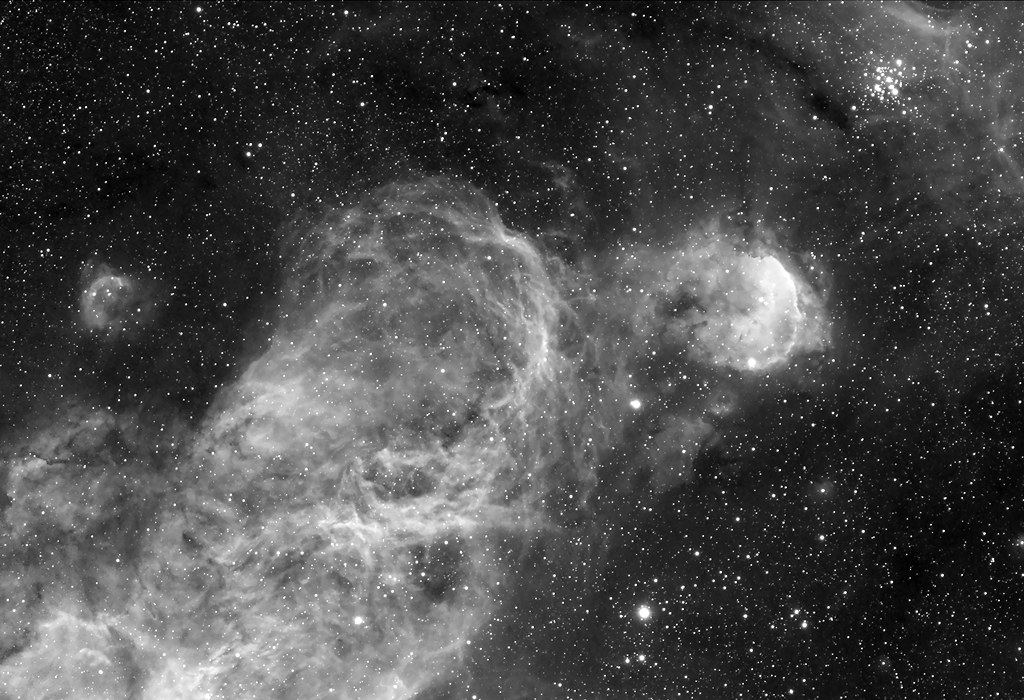
Wolf Rayet 23 - der Stern WR 23, auch als HD 928 09 katalogisiert, ein blauer Stern etwas rechts neben der Bildmitte (siehe auch das beschriftete Bild), ist ein massereicher Stern (30-40 mal so groß wie unsere Sonne) im südlichen Sternbild Carina, etwa 5.900 Lichtjahre von der Erde entfernt. Er ist von einer blasenförmigen Struktur umgeben, die durch intensive stellare Winde entsteht, die mit dem interstellaren Medium in Wechselwirkung tritt, und die die äußeren Gasschichten des Sterns wegblasen. Die Blase dehnt sich mit etwa 10 km/s aus und hat einen Durchmesser von etwa 80 Lichtjahre. Rechnet man zurück, ergibt sich ein Alter der Blase von etwa 700.000 Jahre. WR 23 ist ein Teilbereich des großen Carinanebels NGC 3372. Ein weiteres Beispiel einer WR Blase am südlichen Himmel ist NGC 3199.
Wolf-Rayet-Sterne sind heiße (25.000 - 50.000 K), massereiche (>20 Sonnenmassen) Sterne. Sie durchlaufen eine für sehr massereiche Sterne normale Entwicklung, bei der sie im Vergleich zu unserer Sonne jedes Jahr eine Größenordnung mehr an Sonnenmasse verlieren. Dies geschieht in Form eines sehr starken Sonnenwindes, der mit dem interstellaren Medium in Wechselwirkung tritt und oft "Blasen" erzeugt, wie hier gezeigt. Thor's Helmet (NGC 2359) ist ein nördliches Beispiel für eine solche WR-"Blase". Wolf-Rayet Sterne sind selten, geschätzt gibt es in unserer Milchstraße nur etwa 500 Exemplare. Einen Katalog von Wolf-Rayet Sternen ist hier zu finden.
Object description
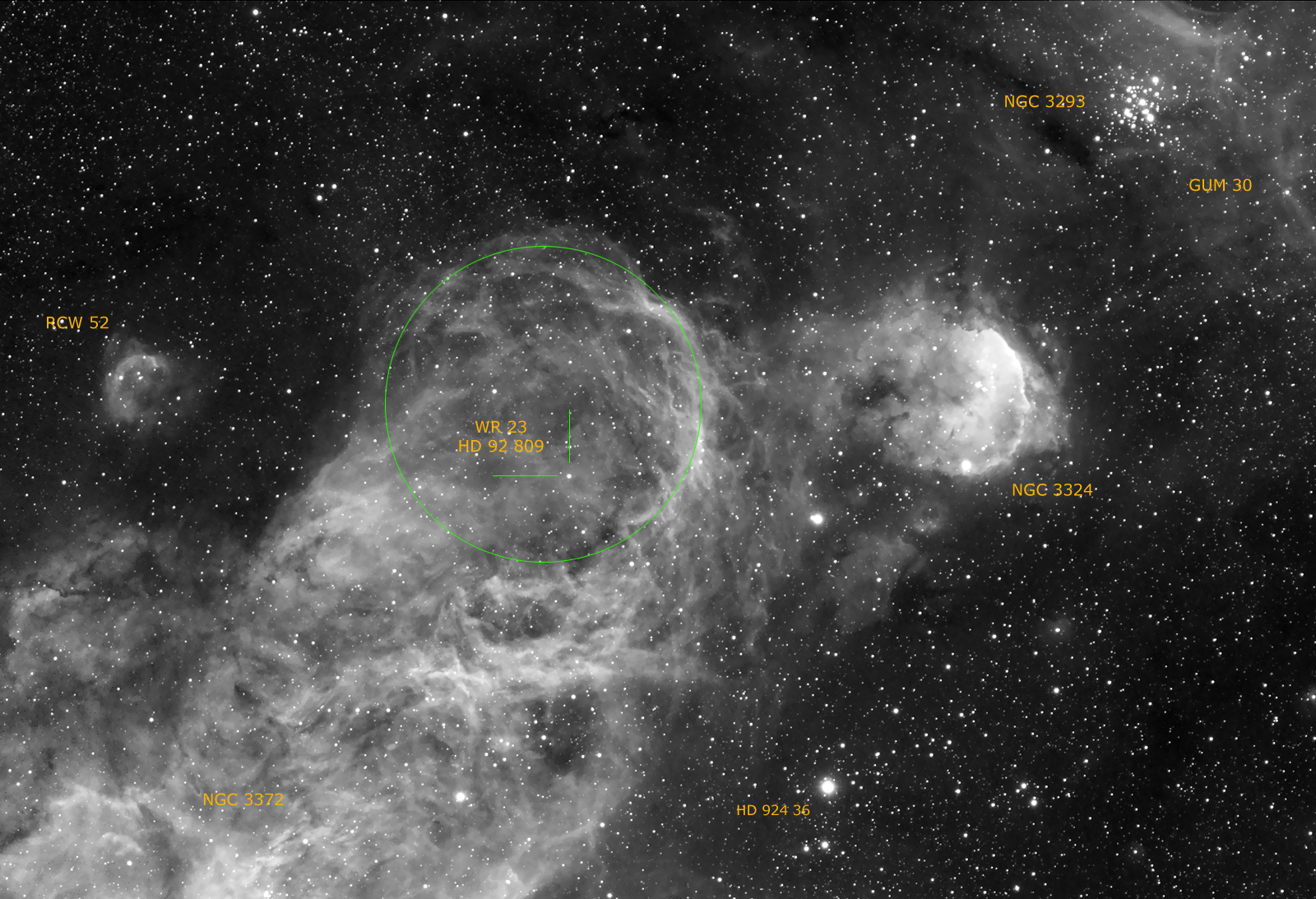
Wolf Rayet 23 - The star WR 23, also cataloged as HD 928 09, a blue star slightly to the right of the center of the image (see also the labeled image), is a massive star (30-40 times the size of our Sun) in the southern constellation Carina, about 5,900 light-years from Earth. It is surrounded by a bubble-like structure created by intense stellar winds interacting with the interstellar medium and blowing away the star's outer layers of gas. The bubble expands at about 10 km/s and has a diameter of about 80 light years. If you calculate backwards, the bubble is about 700,000 years old. WR 23 is a part of the large Carina Nebula NGC 3372. Another example of a WR bubble in the southern sky is NGC 3199.
 |
Wolf-Rayet stars are hot (25,000
- 50,000 K), massive (>20 solar masses) stars. They undergo an evolution
that is normal for very massive stars, in which they lose an order of magnitude
more solar mass every year compared to our Sun. This takes the form of a very
strong solar wind that interacts with the interstellar medium and often
produces "bubbles", as shown here.
Thor's Helmet (NGC 2359) is a northern example of such a WR
"bubble". Wolf-Rayet stars are rare, there are estimated to be only about 700
of them in our Milky Way. A catalog of Wolf-Rayet stars
can b foud here. « Klicken Sie hier oder auf das Vorschaubild zum Laden eines großen Bildes mit Objektbezeichnungen. « Click here or on the thumbnail to load a large image with object annotations. |
The gas bubble around the Wolf-Rayet star 23 (HD 92 809)
Image data
09.05.2025 - total 6 x 600 s, ZWO ASI 071 Pro Color + 7nm Halpha filter (cooled)
Telescope: Pentax SDP 105 mm at f = 670 mm
Location: Chamäleon Observatory, Onjala Lodge, Namibia
Image processing: DeepSkyStacker, PixInsight + Photoshop
 |
 |
 |
 |
 |
 |
 |
| Sonne | Mond | Sonnensystem | DeepSky | Weitwinkel | Verschiedenes | Spez. Projekte |