 |
CHAMÄLEON + ONJALA OBSERVATORY DeepSky | SITEMAP HOME CHAMÄLEON |
|
 |
|||
| « zurück zur Startseite
galaktische Nebel « back to home galactic nebula |
Großes Bild laden - load large image 2048
x 1400 Pixel Aufnahmedaten Image data |
 Objektbeschreibung Objektbeschreibung  Objekt
descripion Objekt
descripion |
NGC 6164/6165 in the constellation Norma
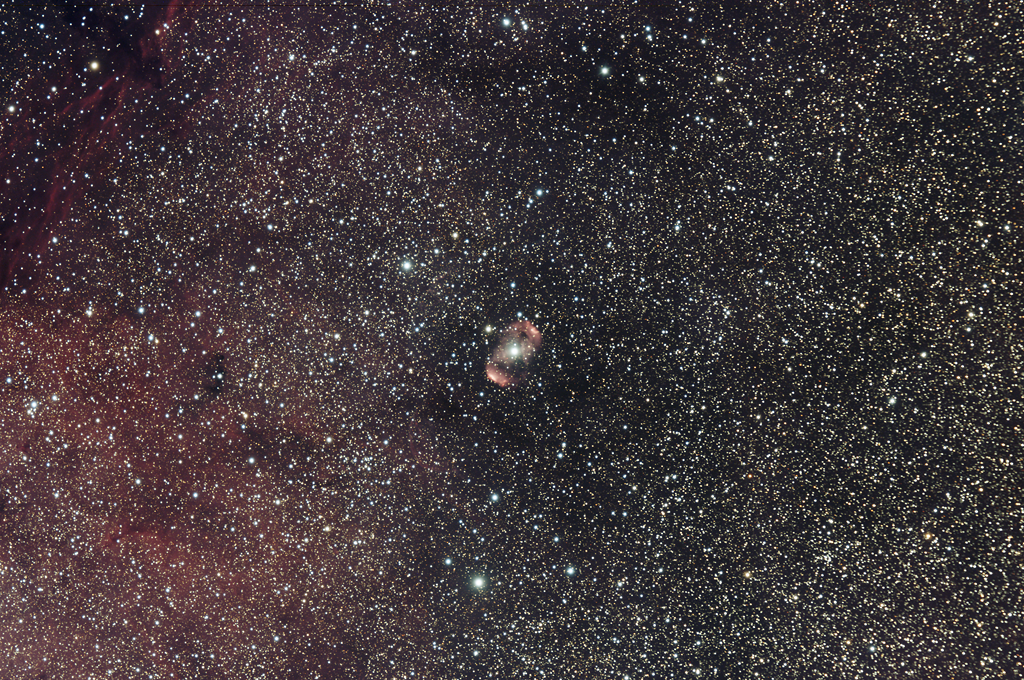
NGC 6164/65 - Unser Bild zeigt den bipolaren Emissionsnebel NGC 6164 (oberer Teil) und NGC 6165 (unterer Teil). Der für den Nebel verantwortliche Wolf-Rayet Stern ist HD 148 937 im Zentrum des Nebels. Es ist ein blauer Überriese mit einem extrem starken Magnetfeld. Von diesen Sternen sind nur sehr wenige in unserer Galaxie bekannt, sie werden deshalb auch als "Magnetsterne" bezeichnet.
HD 148 937 ist vermutlich kein Einzelstern, sondern ein spektroskopischer Doppelstern bestehend aus 2 Komponenten von 34 bzw. 49 Sonnenmassen. Das würde die bipolare Struktur des Emissionsnebel erklären. Das Abströmen der Nebelmaterie aufgrund extrem starker Sternenwinde begann vor etwa 600.000 Jahre. Das System ist etwa 4.000 Lichtjahre vom Sonnensystem entfernt. Der wahre Durchmesser der Gasblase beträgt etwa 4 Lichtjahre.
Eine ausführliche Beschreibung und ein hoch aufgelöstes Bild von uns zeigen wir hier. Die H-II Emission links und oben (nördlich und östlich von NGC 6164/65) im Bild gehören zu NGC 6188. Ein Widefield Mosaik der kompletten Region zeigen wir hier. Die Sterne, die die komplette Region zum Leuchten anregen gehören zum offenen Sternhaufen NGC 6193, von dem wir hier ein hoch aufgelöstes Bild zeigen.
Object description
NGC 6164/65 - Our image shows the bipolar emission nebula NGC 6164 (upper part) and NGC 6165 (lower part). The Wolf-Rayet star responsible for the nebula is HD 148 937 in the center of the nebula. It is a blue supergiant with an extremely strong magnetic field. Very few of these stars are known in our galaxy, which is why they are also called "magnetic stars."
HD 148 937 is probably not a single star, but a spectroscopic binary star consisting of two components with masses of 34 and 49 solar masses, respectively. This would explain the bipolar structure of the emission nebula. The outflow of nebular matter due to extremely strong stellar winds began about 600,000 years ago. The system is about 4,000 light-years away from the solar system. The true diameter of the gas bubble is about 4 light-years.
We show a detailed description and a high-resolution image here. The H-II emission on the left and top (north and east of NGC 6164/65) in the image belongs to NGC 6188. We show a wide-field mosaic of the entire region here. The stars that cause the entire region to glow belong to the open star cluster NGC 6193, of which we show a high-resolution image here.
Image data
17. + 18.07.2025 - total 18 x 600 s, ZWO ASI 071 Color Pro (cooled)
Telescope: Astro Physics EDFS 130mm + Flattener at f = 850 mm
Center Coordinates - RA: 16h 34m 00m, DE: -48 07 00
Location: Chamäleon Observatory, Onjala Lodge, Namibia
Image processing: DeepSkyStacker, PixInsight + Photoshop
 |
 |
 |
 |
 |
 |
 |
| Sonne | Mond | Sonnensystem | DeepSky | Weitwinkel | Verschiedenes | Spez. Projekte |